The Impact of COVID-19 on the Buying and Selling of Companies
1. Evolution of the economy since March 2020
Six months after the declaration of the state of alarm, which lasted three months and brought the whole economy to a halt except for the sectors devoted to supplying basic needs (food, pharmacy, etc.), the economic environment is different from what it was in February. In some sectors linked to tourism and leisure the negative effects have been very severe and the future is still unclear. The tourism sector accounts for 12.3% of GDP and 12.7% of employment in Spain. Hotel stays through September have fallen by 71%.

In the rest of the economic sectors the effects have been smaller and occurred mainly during the three months of the state of alarm; the picture is similar to the one before the state of alarm was decreed, but with some changes.

These changes are not only economic, but also have a social dimension. Online shopping has grown rapidly, remote work has increased substantially, video conferences have eliminated trips, and so on.
Temporary furlough schemes (ERTE), easy access to state-guaranteed loans, remote work, the rapid reorganization of work processes and more have eased the short-term negative effects on companies. The Spanish economy is expected to contract by between 12% and 14% in 2020, the largest contraction in Europe.

What will happen from here? Nobody knows for certain, but it is clear that public administrations will be more indebted and will have higher social spending, there will be more unemployment, companies in general will be more indebted and will earn less money, and consumers in general will be less optimistic about spending.

2. Reaction of public institutions worldwide
Fortunately, European institutions reacted quickly and injected large amounts of funds to keep the economy from plunging.

In addition, central banks around the world have injected large amounts of money at zero interest rates, and governments have injected substantial funds to protect the business fabric.

The stimulus packages in the world’s 20 largest economies have so far been three times larger than those implemented during the 2008 financial crisis.
In principle, these stimulus measures should cushion part of the damage Covid-19 has caused to the economy and make it easier to return to normality, albeit with some changes.
3. Possible future scenarios
Given this picture, we could consider several theories. The first and most optimistic would be a rapid recovery of the economy within one or two years (V Theory). The second would be a slower recovery, two or three years (U Theory). The third would be a long-term recovery, more than three years (L Theory). The fourth is that the economy could go through ups and downs depending on the course of the health situation (W Theory). And the fifth, which could occur within any of the other four, would involve a divergence between sectors, with some recovering after the fall and emerging stronger and others falling irreversibly (K Theory).

Looking at the possible scenarios laid out by the strategy consultancy McKinsey, let us hope that scenario A2 or else B1 occurs, which would mean returning to the same level of GDP as in the fourth quarter of 2019 before the end of 2021.
At the level of individual companies, their future could differ depending on their size (large ones would overcome future obstacles better), sector (those linked to tourism and leisure could be the most negatively affected), market (those that export the most would have more opportunities) and the attitude of business owners and managers (those who see these changes as an opportunity to improve, make sound decisions and implement them properly will emerge stronger in any scenario).

4. Alternatives for business owners who want to sell their company
Companies that reacted well and quickly when the importance of Covid-19 became clear are now in a healthier position. However, they now have to adapt to the new, uncertain environment in the right way, and this will require taking risky decisions. It will mean reorganizing the company at a strategic level, which will bring changes in the commercial, production, financial and human resources areas. This new, more VUCA environment (volatile, uncertain, complex and ambiguous) will be favorable for well-positioned, ambitious, proactive and agile companies. On the other hand, it will be unfavorable for companies that are poorly positioned, reactive, lacking in ambition and slow.
Now, business owners who want to sell their company, whether for personal reasons (age, health, lack of enthusiasm, other goals, etc.) or for business reasons (strong and aggressive competitors, lack of financial resources, lack of human resources, etc.), have two options: the first is to wait and see what happens in the environment, and the second is to act proactively. Whichever they choose, it is an indispensable condition that they manage the company well in a way that preserves or increases the value of the company; now more than ever, they must devote themselves to the business.
If they choose to wait and see what happens in the economic environment, two things can happen. One is that the company performs well, in which case its appeal and value to a potential buyer will increase. Conversely, if the company performs poorly, its appeal and value to a potential buyer will decrease.
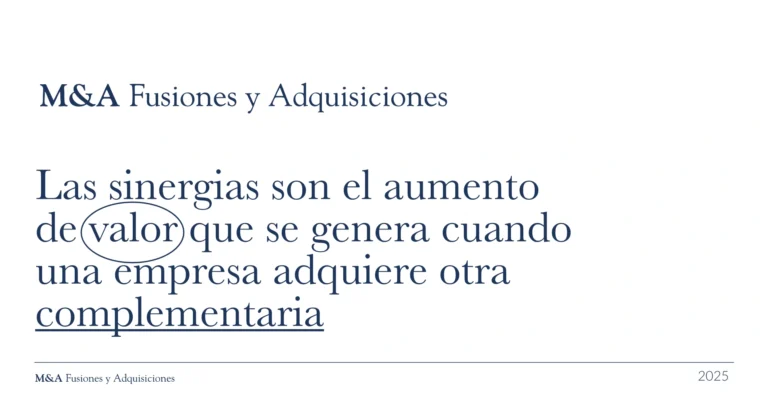
On the other hand, if they choose to look for a buyer now the appeal and value of the company to a potential buyer will depend on how potential buyers view the future. There are two types of potential buyers: strategic and financial. If potential strategic buyers want to strengthen themselves for an increasingly VUCA future (volatile, uncertain, complex and ambiguous), they will look very eagerly at the option of buying a company, provided that the acquisition helps reinforce their position in the market. The acquisition can then increase their share in the market where they are already present, take them into a new complementary market, give them a new complementary product line, bring new know-how, reduce costs, and so on.
In the case of financial buyers they are driven by other parameters: their goal is to buy companies that they believe will perform very well once acquired and thus increase in value. To have this potential for value growth in the future, the companies they acquire must have: competitive advantages, good positioning, the possibility of growing sales, whether with current products in current markets and/or in new markets and/or with new products, and room for improvement in costs and in the management of investments, inventories, collections and payments.
Both potential strategic buyers -who want to reinforce their position in the market- and financial buyers -who want to make good investments- have their antennae up and are in a proactive position to acquire companies. Strategic buyers know that the opportunity to buy a complementary company is unique and should be seized as soon as possible, because if the chance is missed, the train is lost (a competitor buys it) and perhaps another train as interesting will not come again. Financial buyers are Private Equity firms that hold funds contributed by institutional investors and high-net-worth individuals, which they must invest one way or another, since if they are not invested, they expire like fruit.
If a business owner expects that their company will not perform well in the future, they should think about the metaphor of the frog and the pot of hot water. If we put a frog in a pot of lukewarm water and the water is gradually heated, by the time the frog realizes the water is very hot, it is already cooked and cannot get out of the pot. If, however, we put a frog in a pot of very hot water, the frog jumps out immediately, before it is cooked.
This article is the continuation of the first article “How could the economic landscape look in the short term because of the coronavirus?”.